
Agri-Fi: The Beginner’s Guide to the Future of Farming and Finance

Imagine if you could fund a coffee harvest in Colombia or a rice paddy in Thailand directly from your smartphone, earning a return when the crops are sold. This isn’t science fiction—it is the booming reality of Agri-Fi.
As the world grapples with food security and volatile markets, a new financial model is emerging that bridges the gap between the food on our plates and the money in our pockets. But what exactly is Agri-Fi, and why is it attracting everyone from tech-savvy investors to sustainable living enthusiasts?
Here is your comprehensive, easy-to-understand guide to the world of Agricultural Finance.
What is Agri-Fi?
Agri-Fi is short for Agricultural Finance. At its core, it is the intersection where agriculture meets modern finance and technology.
In the past, if a farmer needed money to plant seeds, they had to rely on slow, traditional banks or expensive local lenders. Agri-Fi changes the game by using FinTech (financial technology) to connect farmers directly with investors—often regular people like you.
Think of it as “Kickstarter for farms.” You provide the capital the farmer needs to grow crops, and in return, you share in the profits after the harvest.
The “Why” Behind the Movement
- Food Security: The world population is growing, and we need more efficient ways to fund food production.
- Financial Inclusion: Small farmers often can’t get bank loans. Agri-Fi gives them a financial lifeline.
- Smart Investing: It opens up agriculture—a historically stable asset class—to everyone, not just the ultra-wealthy.
The Problem: The “Harvest Gap”
To understand why Agri-Fi is necessary, we have to look at the unique struggle of farming.
The Timing Mismatch
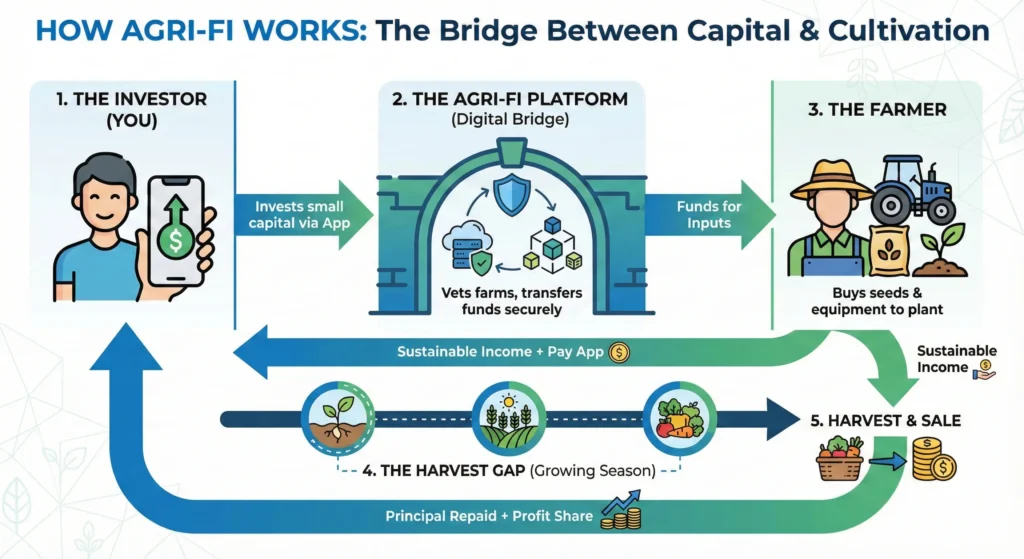
Most businesses sell products every day. Farmers are different. They have to spend huge amounts of money upfront on seeds, fertilizer, labor, and equipment. However, they don’t get paid until the harvest is sold, which could be 6 to 12 months later.
This creates a “Harvest Gap”—a dangerous period where the farmer is cash-poor and vulnerable.
The “Unbanked” Farmer
In many developing nations, farmers work in rural areas far from bank branches. They may lack a credit score or formal paperwork. Traditional banks view them as “too risky,” leaving them vulnerable to loan sharks with predatory interest rates.
How Agri-Fi Works: Bridging the Gap
Agri-Fi platforms act as a digital bridge. They use technology to facilitate money movement, ensuring transparency for the investor and quick access for the farmer.
Here are the three main models you will see in the Agri-Fi space:
Crowdfunding Agriculture
This is the most common model for beginners.
- How it works: A platform lists a specific project (e.g., “Plant 500 Avocado Trees”).
- Your Role: You and hundreds of others chip in small amounts (e.g., $50).
- The Result: The farmer gets the cash to plant. When the avocados are sold, the principal is returned to you plus a share of the profit.
Micro-Lending
Instead of owning a share of the crop, you provide a loan.
- The Use Case: A farmer needs $200 for a new water pump.
- The Return: The farmer repays the loan over time with interest.
Blockchain and Tokenization
This is where Web3 and Crypto meet farming.
- Tokenization: A physical asset (like a cow or a ton of corn) is represented by a digital token on a blockchain.
- Transparency: Because blockchain records cannot be altered, investors can track exactly where their money went—verifying that it bought seeds, not a new TV.
Why Investors Are Flocking to Agri-Fi
Why would a general user invest in a farm? There are three distinct pillars of value.
Impact Investing (Doing Good)
This is money with a mission. You aren’t just watching numbers go up on a screen; you are helping a real person put food on their table and yours. It empowers farmers to expand their business and send their children to school.
Asset Diversification
The stock market is volatile. Tech stocks might crash because of a bad news cycle, but people always need to eat. Agriculture is often “uncorrelated” to the stock market, making it a great safety net for your investment portfolio.
Hedge Against Inflation
As food prices rise (inflation), the value of crops goes up. If you are invested in those crops, your returns often rise along with inflation, protecting your purchasing power.
Safety First: The Smart Investor’s Checklist
Because Agri-Fi often happens online, it can be a target for scammers. Before you put a single dollar into a digital farm, use this 5-step checklist to separate the legitimate platforms from the fakes.
- The “Too Good to Be True” Test: In agriculture, nothing is guaranteed. If a platform promises “Guaranteed 20% Returns,” run away. Legitimate platforms speak openly about risks (weather, pests) and give you a projected return range.
- Verify the Dirt (Literally): Does the farm actually exist? A real project will often provide coordinates you can check on Google Earth or specific details about the region.
- Who is Behind the Screen? Check the “About Us” page. If the team is anonymous or uses cartoon avatars, that is a red flag. Legitimate founders have a traceable history on LinkedIn.
- Is There Crop Insurance? What happens if a typhoon wipes out the harvest? The best Agri-Fi platforms have crop insurance policies that protect your principal investment if a natural disaster strikes.
- Follow the Money: How does the platform make money? They should charge a clear service fee or take a percentage of the profits. If they claim to be “fee-free,” they might be selling your data—or worse.
Frequently Asked Questions (FAQ)
To help you better understand Agri-Fi, here are answers to the most common questions.
What is the difference between Agri-Fi and DeFi?
Agri-Fi (Agricultural Finance) focuses specifically on funding real-world agricultural projects, often connecting investors to physical farms. DeFi (Decentralized Finance) is a broader term for financial services on the blockchain that operate without banks. While Agri-Fi can use DeFi technology, its primary purpose is supporting agriculture.
How much money do I need to start investing in Agri-Fi?
Barriers to entry are low. Many crowdfunding Agri-Fi platforms allow you to start with as little as $20 to $50. This makes it accessible for everyday users who want to dip their toes into agricultural investing without buying a whole farm.
Is Agri-Fi safe for beginners?
Like all investments, Agri-Fi carries risk. While it offers the security of a physical asset (the crops), it is subject to weather and market risks. Beginners should look for platforms that offer crop insurance or buy-back guarantees to minimize potential losses.
How do Agri-Fi platforms make money?
Most platforms charge a small service fee or take a percentage of the profit from the harvest. Some also charge a transaction fee when you deposit or withdraw funds. Always read the fee structure before investing.
Can I visit the farm I invested in?
Some “farm-to-table” style Agri-Fi platforms actually encourage this! They may offer farm visits as a perk for investors, allowing you to see exactly where your money is going and meet the farmers you are supporting.
Conclusion
Agri-Fi is more than just a buzzword; it is a necessary evolution of our global food system. It democratizes access to capital for the people who feed us, and it democratizes access to high-quality investments for the rest of us.
Whether you are looking to diversify your portfolio or simply want to know that your money is making a tangible difference in the world, Agri-Fi offers a fertile ground for growth—provided you do your homework first.