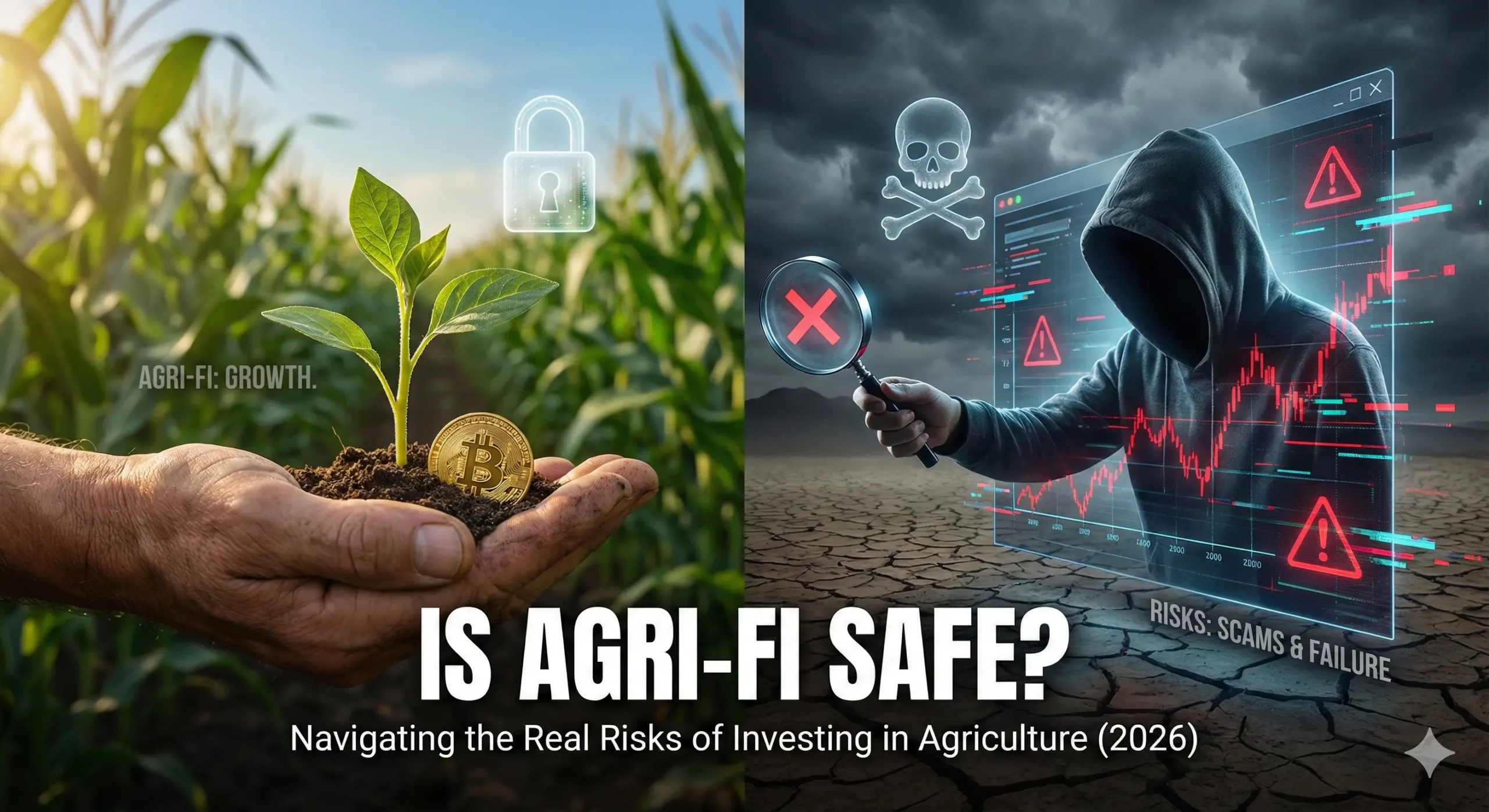
Is Agri-Fi Safe? The Real Risks of Investing in Agriculture (2026)

You are ready to invest and like the idea of owning land,and maybe even read our guide on how to buy your first farmland asset but there is a voice in the back of your head asking: “Is this too good to be true? What if the crops die? What if the website disappears tomorrow?” These are not paranoid questions; they are smart questions.
Agri-Fi (Agricultural Finance) is a mix of two high-risk industries: Crypto and Farming. If anyone tells you it is “100% Safe,” run away. In this guide, we are going to look the monster in the eye. We will separate the “Bad Luck” (Crop Failure) from the “Bad Actors” (Scams), and give you a checklist to stay safe.
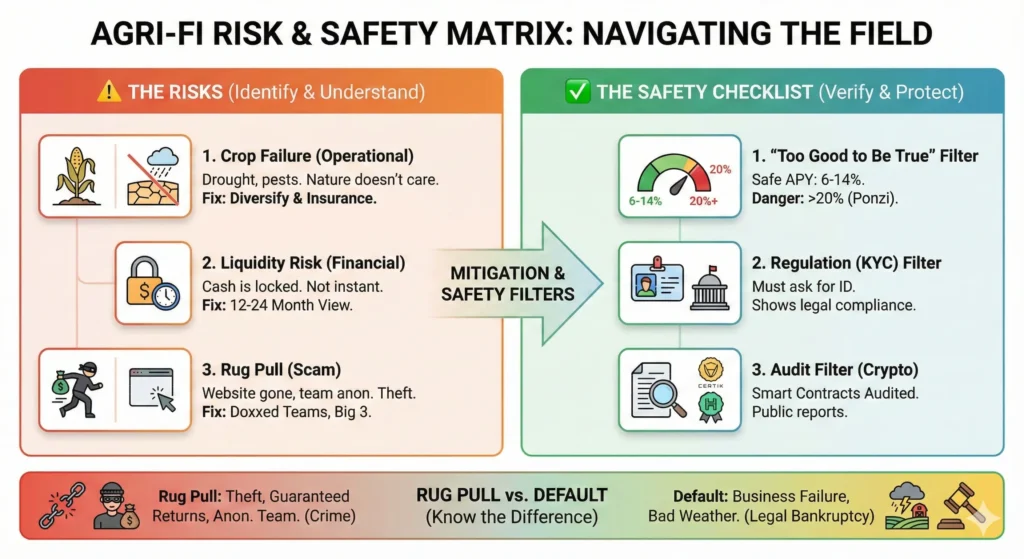
⚠️ The 3 “Big Bad” Risks (And How to Mitigate Them)
1. The “Crop Failure” Risk (Operational)
This is the most honest risk. Farming is hard.
- The Scenario: You invest $100 in a corn farm in Brazil. A massive drought hits. The corn dies. The farmer cannot repay the loan.
- The Reality: This happens. Unlike a bank CD, Mother Nature does not care about your yield.
- 🛡️ The Fix:
- Diversify: Never put $1,000 into one farm; read our guide on the 4 ways to invest with little money Put $100 into 10 different farms in different countries (e.g., Dairy in USA + Olives in Spain + Rice in Vietnam). It is unlikely a drought will hit the whole planet at once.
- Check for Insurance: Platforms like Steward often work with farmers who have USDA Crop Insurance. Always check the project details for “Crop Insurance.”
2. The “Liquidity” Risk (Financial)
- The Scenario: You buy $5,000 worth of LandShare tokens. Suddenly, you need cash for a medical emergency. You try to sell, but nobody is buying.
- The Reality: Real estate is “Illiquid.” You cannot press a button and get cash instantly like you can with Bitcoin or Apple Stock.
- 🛡️ The Fix:
- Treat this investment like a “Lockbox.” This is a key part of building a long-term lending strategy
- Only invest money you do not need to touch for 12–24 months.
3. The “Rug Pull” Risk (Scam)
- The Scenario: A new site called “SuperFarmYield.io” launches, promising 500% APY. You deposit money. Two weeks later, the website is gone and their Twitter is deleted.
- The Reality: In the crypto world, this is common.
- 🛡️ The Fix:
- Stick to the top rated Agri-Fi platforms Steward, InSoil, and LandShare have years of track records and public teams.
- The “LinkedIn Test”: Can you find the CEO on LinkedIn? Do they have a face? If the team is “Anonymous cartoons,” do not invest.
🥊 The Showdown: “Rug Pull” vs. “Default”
New investors often confuse these two. It is vital to know the difference.
| Feature | Rug Pull (Theft) | Default (Business Failure) |
| What happened? | The owners stole the money and ran. | The business tried but failed to make a profit. |
| Did you lose money? | Yes, 100%. | Yes, usually partial or total. |
| Is it legal? | No. It is a crime. | Yes. Bankruptcy is legal. |
| Warning Sign | “Guaranteed Returns,” Anonymous Team. | Bad weather, poor market prices. |
Key Takeaway: A platform can be honest and you can still lose money (Default). That is investing. Your job is to avoid the dishonest ones (Rug Pulls).
🚩 The Red Flag Database: 4 Signs of a Scam
Before you connect your wallet, scan the website for these immediate warning signs.
1. The “Guaranteed” Promise No investment on earth is guaranteed. If a site says “Guaranteed 20% Returns,” it is likely a Ponzi scheme. Legitimate sites will always use careful language like “Projected Returns” or “Historical Returns.” If they promise you a fixed, high win rate with zero risk, do not invest.
2. The “Anonymous” Team Always check the “About Us” page. A legitimate project will have photos of real people, links to their LinkedIn profiles, and a physical office address. Be extremely wary of projects that only show cartoon avatars, list no names, or provide a generic address in an offshore location like the Cayman Islands.
3. The “High Pressure” Timer Scammers want you to panic-buy so you don’t do your research. Watch out for flashing banners that say “Offer expires in 10 minutes!” or “Only 2 spots left!” Legitimate platforms want you to read the legal documents and rarely use aggressive countdown timers.
4. The “Send Crypto Directly” Request This is the most common scam. Be suspicious if a Telegram admin or support agent asks you to “Send USDT to this wallet address to verify your account.” You should only ever deposit funds through the official website dashboard or a verified smart contract interaction.
🆘 Recovery Plan: What to Do If Things Go Wrong
Even with the best preparation, things happen. Here is your emergency protocol.
Scenario A: The Platform Website is Down First, do not panic. It is often just server maintenance. Immediately check their official social channels like X (Twitter) or Discord to see if other users are complaining or if the team has posted an update. If it is a crypto-based platform like LandShare, remember that your tokens are safely in your wallet, not on their website. You still own the underlying asset even if their front-end interface crashes.
Scenario B: A Loan Defaults If a farmer cannot pay, the platform will typically send an official update explaining the cause (e.g., “Farmer John had a bad harvest”). You then need to wait for the recovery process, where the platform’s legal team attempts to seize and sell assets like tractors or land to repay investors. This process can take 6–18 months. If recovery fails, you can often claim the loss on your taxes as a capital loss (consult your CPA) protocol.
✅ The 2-Minute Safety Checklist
Before you connect your wallet or bank account, run the platform through this quick filter.
1. The “Too Good To Be True” Filter 📉 Check the Annual Percentage Yield (APY). A range of 6% to 14% is normal for private lending and indicates a healthy project. However, be extremely cautious of anything promising 20% to 100%+ APY. Real farms rarely make that much profit; if the returns are that high, it is usually a Ponzi scheme funded by new investors rather than actual crops.
2. The “Regulation” Filter ⚖️ Look for “KYC” (Know Your Customer) requirements. If a platform asks for your ID, it is a good sign that they are compliant with the law and legitimate. Conversely, if a site advertises “No KYC needed!” or “Anonymous investing,” treat it as a major red flag. Legitimate finance platforms always need to know who you are.
3. The “Audit” Filter 📝 If you are looking at a crypto-based project like LandShare, verify that their smart contracts have been audited. Scroll to the footer of their website and look for security badges from reputable firms like Certik or Hacken. If they don’t have these, your funds could be vulnerable to bugs or hacks.
Conclusion: Is it Safe?
Agri-Fi is ultimately as safe as the farmer you are lending to. It sits in the “Goldilocks Zone” of investing: safer than speculative meme coins, but riskier than an FDIC-insured savings account. While no investment is without risk, you can mitigate the dangers by sticking to regulated platforms with public teams and diversifying your capital across multiple farms. If you follow these safety checks, you can build a portfolio that is not just digital numbers, but backed by the most valuable asset on earth: food.
Disclaimer: The information provided in this article is for educational and informational purposes only and should not be construed as financial, legal, or investment advice. Agri-Fi and cryptocurrency investments carry inherent risks, including the potential loss of principal. Always conduct your own due diligence and consult with a certified financial advisor before making any investment decisions. This article may contain affiliate links, which means we may earn a commission if you make a purchase through our links at no additional cost to you.