How to Invest in Farmland with Little Money: A Step-by-Step Guide for 2026

For decades, farmland was the secret weapon of the ultra-wealthy. Bill Gates didn’t become the largest private farmland owner in America by accident—he did it because land is a stable, inflation-proof asset that keeps growing in value while the stock market rollercoasters.
But until recently, if you didn’t have $1 million to buy 100 acres and a tractor, you were locked out.
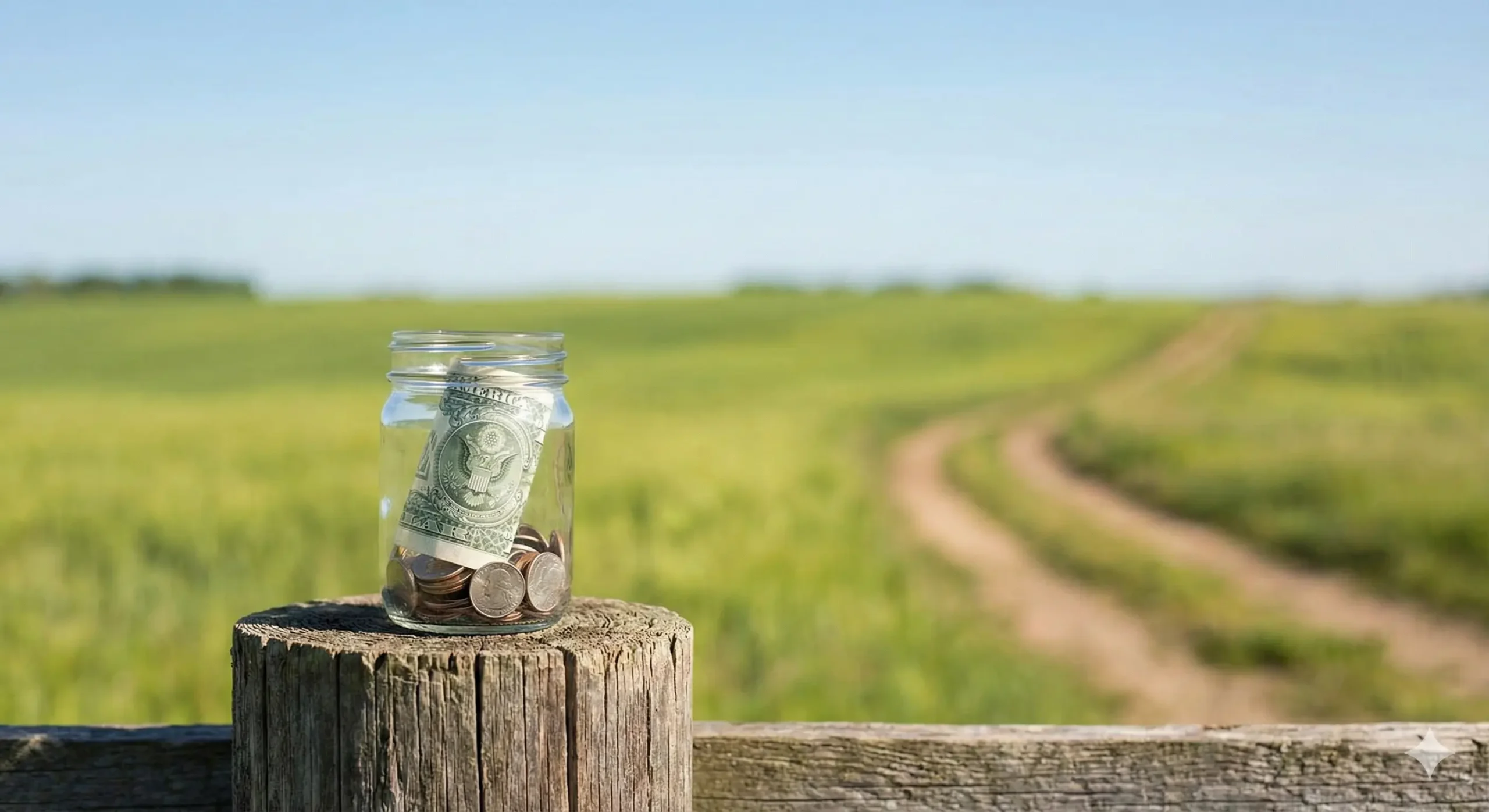
Welcome to 2026. Technology has finally broken the barrier. Today, you can own a piece of a cornfield in Iowa or a vineyard in France for less than the cost of a dinner date.
This guide will show you exactly how to start building your agricultural empire with “pocket change.”
Note: We are not financial advisors. This guide is for educational and entertainment purposes only—always do your own research before investing!
Why Invest in Farmland Now? (The 2026 Outlook)
Before we get to the “How,” let’s briefly look at the “Why.”
- The “Capital Crunch”: Economic forecasts for 2026 suggest farmers are facing tighter profit margins. This sounds bad, but for investors, it’s an opportunity. Farmers need liquid cash more than ever, which means more high-quality farms are listing on crowdfunding platforms to raise capital.
- Inflation Hedge: Even as inflation settles, food prices rarely go down. Owning the land that produces food protects your purchasing power.
- Low Volatility: When tech stocks crash, people still eat. Farmland has historically delivered positive returns even during recessions.
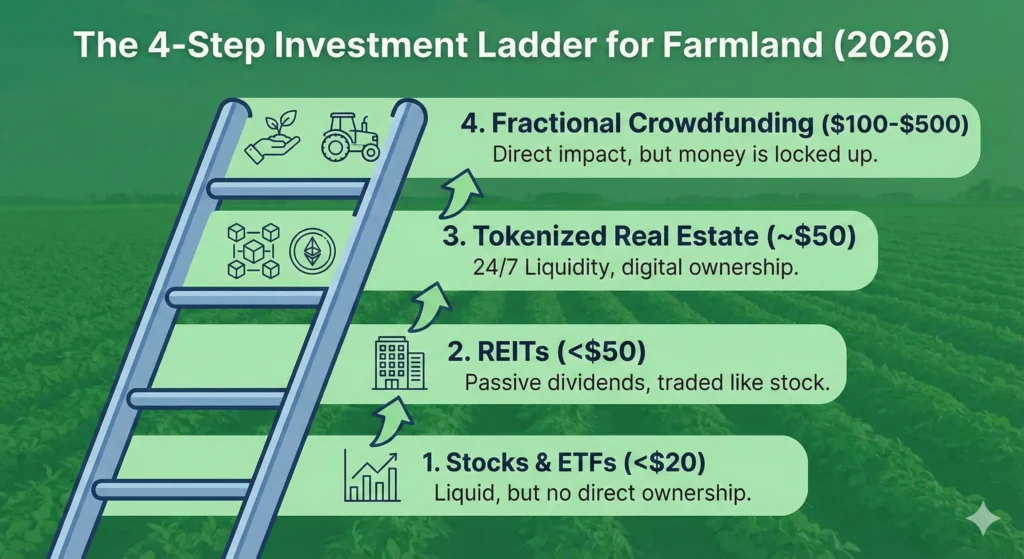
The 4 Ways to Invest (Ranked by Budget)
We have ranked these methods from “Cheapest & Easiest” to “Most Direct Ownership.”
1. Agriculture Stocks & ETFs (Entry: < $20)
The “Wall Street” Way.
If you have a brokerage account (like Robinhood or Fidelity), you can start in 5 minutes. You aren’t buying the farm itself; you are buying the companies that support the farm.
- What to buy: Stocks like John Deere (DE) or fertilizer giants like Nutrien (NTR). You can also buy ETFs like the VanEck Agribusiness ETF (MOO) which holds a basket of these companies.
- Pros: Deeply liquid (you can sell instantly).
- Cons: You don’t own the dirt. If the stock market crashes, these stocks usually crash too.
2. Farmland REITs (Entry: < $50)
The “Landlord” Way.
A REIT (Real Estate Investment Trust) is a company that owns farmland and rents it out to farmers. They trade on the stock market just like Apple or Tesla.
- Top Picks: Companies like Gladstone Land (LAND) own fruit and vegetable farms in the US and pay monthly dividends.
- Pros: You get regular dividend checks (passive income).
- Cons: You have no control over which farms they buy.
3. Tokenized Real Estate (Entry: ~$50)
The “2026 Tech” Way.
This is the breakout trend for 2026. Tokenization uses blockchain technology to slice a single property into thousands of digital “tokens.”
- How it works: A $100,000 farm is split into 2,000 tokens worth $50 each. You buy 1 token. You now own 0.05% of that farm.
- Pros: Liquidity. Unlike traditional crowdfunding, you can often sell your tokens 24/7 on a secondary market.
- Cons: Tech learning curve (you may need a digital wallet).
4. Fractional Crowdfunding (Entry: $100 – $500)
The “Agri-Fi” Way.
This is the sweet spot for most investors. You pool your money with others to fund a specific farm or loan.
- Where to go: Platforms like Steward allow you to lend as little as $100 to sustainable family farms, while HeavyFinance lets you fund agricultural machinery loans.
- Pros: You know exactly where your money is going (e.g., “I funded a tractor in Poland”).
- Cons: Illiquidity. Your money is usually locked up for 1–3 years until the loan is repaid.
There are dozens of sites to choose from, but not all are safe. We tested the biggest names in the industry—read our comparison of the Top 7 Agri-Fi Platforms for 2026 to see which one fits your budget.
Step-by-Step Guide: Your First $100 Investment
Ready to pull the trigger? Here is a safe path for a beginner.
- Choose Your “Risk Flavor”: Do you want safety? Choose a REIT or a secured loan platform where machinery backs your money. Do you want high growth? Look for Equity Crowdfunding (owning the crop yield).
- Check the Vetting: Don’t just look at the pretty pictures of cornfields. Check the LTV (Loan-to-Value). If a farmer wants a $100k loan but offers $200k in collateral (50% LTV), that is a safer bet.
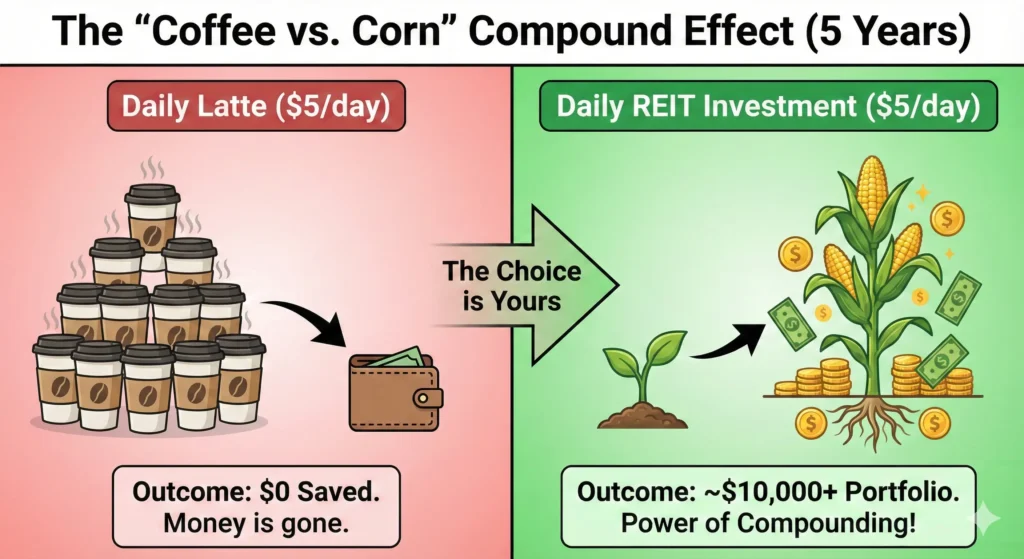
- The “Coffee Strategy”: Don’t try to time the market. Instead of buying a $5 latte tomorrow, put that $5 into a Farmland REIT. Do this once a week. By the end of 2026, you will have a diversified farmland portfolio worth over $250.
The “Hidden” Costs of Low-Budget Investing
We believe in transparency. Here is what most guides won’t tell you about investing small amounts.
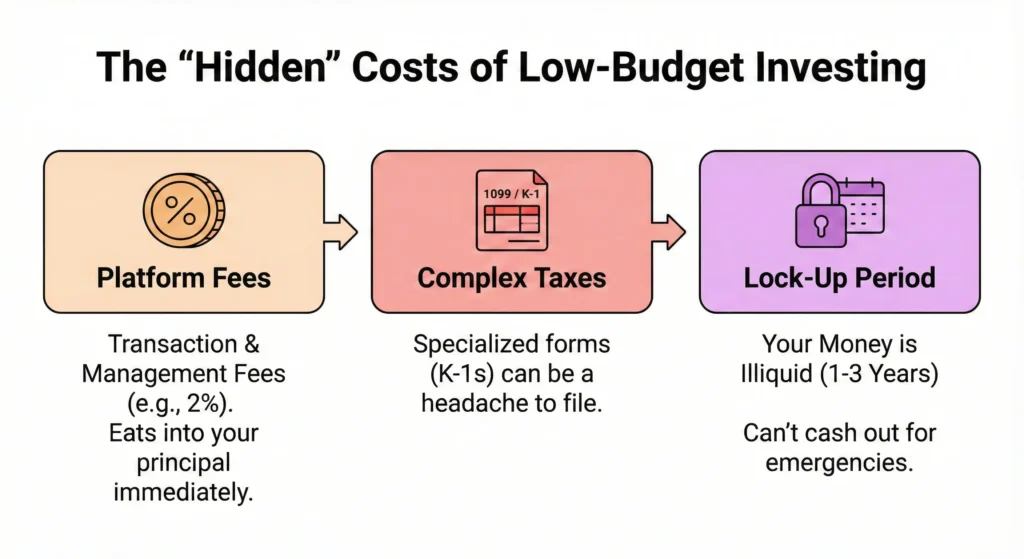
- Platform Fees: If you invest $50 but the platform charges a $2 transaction fee, you just lost 4% of your money immediately. Always check the fee structure!
- Taxes: Some crowdfunding platforms issue complex tax forms (like K-1s) which can be annoying to file. REITs and Stocks are much simpler for taxes.
- The Lock-Up: Remember, you can’t cash out a crowdfunding investment if your car breaks down. Only invest money you don’t need for 12 months.
Frequently Asked Questions (Agri-Fi Simply Explained)
Can I really invest if I’m not rich? Yes! In the old days, you needed $1 million to buy a farm. Today, thanks to Crowdfunding and REITs, you can start with as little as $50 to $100. Think of it like chipping in for a pizza—you don’t have to buy the whole pie to get a slice.
What is a “REIT” and why should I care? Think of a REIT (Real Estate Investment Trust) like a mutual fund for land. Instead of you going out and buying a cornfield, you buy stock in a company that already owns 100 cornfields. They do all the hard work (finding tenants, collecting rent), and they just send you a share of the profit (dividends). It’s the easiest way to start.
Can I get my money back whenever I want? It depends. If you buy a REIT, yes—it’s like selling a stock. But if you fund a specific farm project on a crowdfunding site, your money is usually “locked up” for 1 to 3 years until the harvest is sold or the loan is repaid.
What happens at tax time? Is it a nightmare? It can be. If you buy a public REIT, you get a simple form (1099) that is easy to file. If you invest directly in a farm project, you might get a specialized form called a K-1, which arrives late in the year and is more complex. Always check the platform’s FAQ before investing.
Is my money safe? What if the crops die? There are two types of safety. If you invest in a “loan” (lending money for a tractor), you are safer—the farmer still owes you money even if the crops fail. If you invest in “equity” (owning the crops), you share the risk. If a storm wipes out the harvest, you might lose profit.
Conclusion
In 2026, you don’t need overalls or a tractor to be a farmer. You just need a smartphone and $50.
Whether you choose the stability of a REIT or the impact of lending to a sustainable farm, the most important step is the first one. Don’t let your money sit in a bank losing value to inflation. Plant it, and let the “magic of compound interest” do the farming for you.
Disclaimer: The content on this page is for educational and entertainment purposes only and does not constitute financial, legal, or investment advice. Agriculture investments carry inherent risks, including loss of principal. We are not financial advisors; please consult a certified professional before making any investment decisions. For more details, please read our full Disclaimer here