Top 7 Agri-Fi Platforms for 2026: Safe Investing Reviewed

If 2025 was the year Agri-Fi (Agricultural Finance) hit the mainstream, 2026 is the year it matures.
Gone are the days of guessing which app might survive. The industry has settled, and clear winners have emerged. Investors today aren’t just looking for “cool tech”—they want stability, verified track records, and sustainable returns.
But with dozens of platforms promising high yields, how do you separate the serious business from the hype?
We analyzed the market to bring you the Top 7 Agri-Fi Platforms for 2026. Whether you have $50 or $50,000, there is a way for you to plant your money and watch it grow.
How We Ranked These Platforms
Before we dive into the list, you should know what we looked for. We ranked these platforms based on three non-negotiable criteria:
- Track Record: Have they successfully paid back investors in previous years?
- Asset Protection: Is the investment backed by real collateral (like land or heavy machinery)?
- Accessibility: Can a regular person use it, or is it only for millionaires?
The Top 7 Agri-Fi Platforms for 2026
1. AcreTrader (The Industry Standard)
Best For: Serious investors looking for land ownership.
AcreTrader is often called the “Stock Market for Farmland.” They don’t just fund crops; they buy the actual land. When you invest, you are buying shares of a specific farm in the US. You earn money in two ways: annual rent paid by the farmer, and land appreciation when the farm is eventually sold.
- Minimum Investment: Usually $15,000 – $20,000.
- The Pro: extremely safe structure. You own the land title.
- The Con: High barrier to entry (mostly for Accredited Investors).
2. Steward (The Sustainable Choice)
Best For: Beginners and Eco-Conscious Investors.
Steward is unique because it focuses entirely on Regenerative Agriculture—sustainable, family-owned farms that help the environment.1 Unlike AcreTrader, this is a crowd-lending platform. You are lending money to a farmer to buy a greenhouse or a tractor, and they pay you back with interest.
- Minimum Investment: Low (often starting at $100).
- The Pro: meaningful impact. You can see exactly which family farm you are helping.
- The Con: Returns are generally lower (around 6-8%) compared to riskier platforms.
3. HeavyFinance (The Equipment Specialist)
Best For: European exposure and steady returns.
Most platforms lend against crops (which can die). HeavyFinance lends against Machinery.2 Farmers need loans to buy tractors and combines. If the farmer can’t pay, the platform can sell the tractor to recover your money. This “hard collateral” makes it a favorite for risk-averse investors.
- Minimum Investment: Very Low (often €50).
- The Pro: Equipment is easier to sell than a half-grown crop if things go wrong.
- The Con: primarily focused on the European market (though open to global investors).
4. LandShare (The Blockchain Leader)
Best For: Tech-savvy users and Crypto investors.
If you are comfortable with Web3, LandShare offers the most liquid way to invest in real estate. They use Tokenization to put real-world properties on the blockchain. Instead of signing paperwork, you buy a digital token that represents your share of the property.
- Minimum Investment: ~$50 (depending on token price).
- The Pro: Liquidity. Unlike other platforms where your money is locked for years, you can sell your LandShare tokens instantly on an exchange.3
- The Con: Requires knowledge of crypto wallets (Metamask, etc.).
5. FarmTogether
Best For: Passive Income seekers.
Similar to AcreTrader, FarmTogether focuses on top-tier US farmland (like almond orchards in California or citrus groves in Florida).4 They are famous for their rigorous vetting process—they reject about 98% of the deals they see, ensuring only the highest quality farms make it to the platform.
- Minimum Investment: High ($15,000+).
- The Pro: “Set it and forget it.” They handle absolutely everything.
- The Con: Your money is locked up for long periods (5-10 years).
6. Harvest Returns
Best For: Variety of choices.
Harvest Returns is interesting because it offers a mix. You can find high-tech indoor vertical farming deals, grass-fed cattle operations, or timberland. They cater to both accredited and non-accredited investors (depending on the specific deal).
- Minimum Investment: Varies ($5,000 – $10,000).
- The Pro: Great diversity of agricultural sectors.
- The Con: Platform interface can be a bit more complex than Steward.
7. ProducePay
Best For: Understanding the Supply Chain.
Note: ProducePay is largely B2B (Business to Business), but it is essential to watch in 2026. They connect growers directly to retailers, cutting out the middlemen.5 While direct investment options for individuals are limited compared to others, they are the backbone of modern Agri-Fi. Keep an eye on them for any retail products launching in 2026.
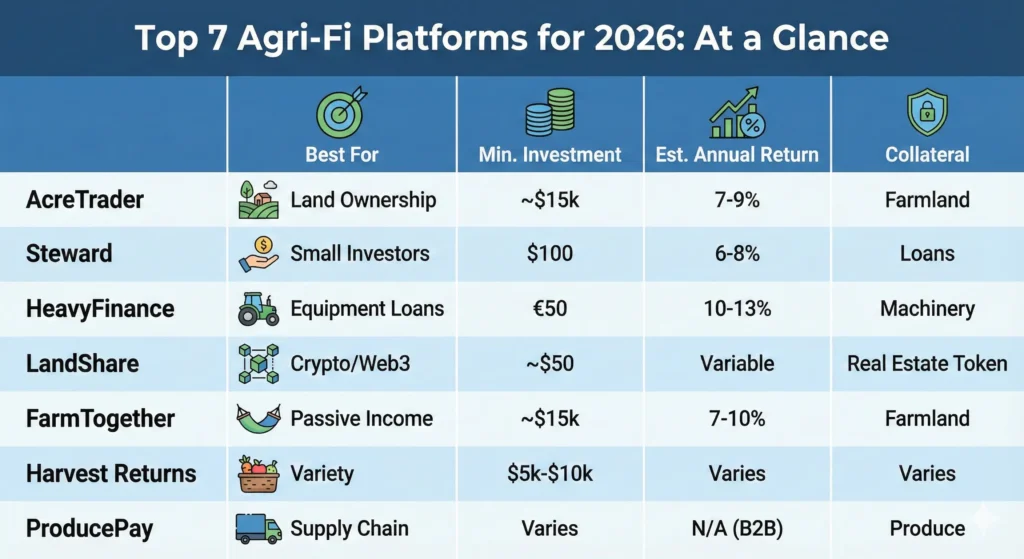
At a Glance: Comparison Table
The 2026 Trend: “Green” is the New Gold
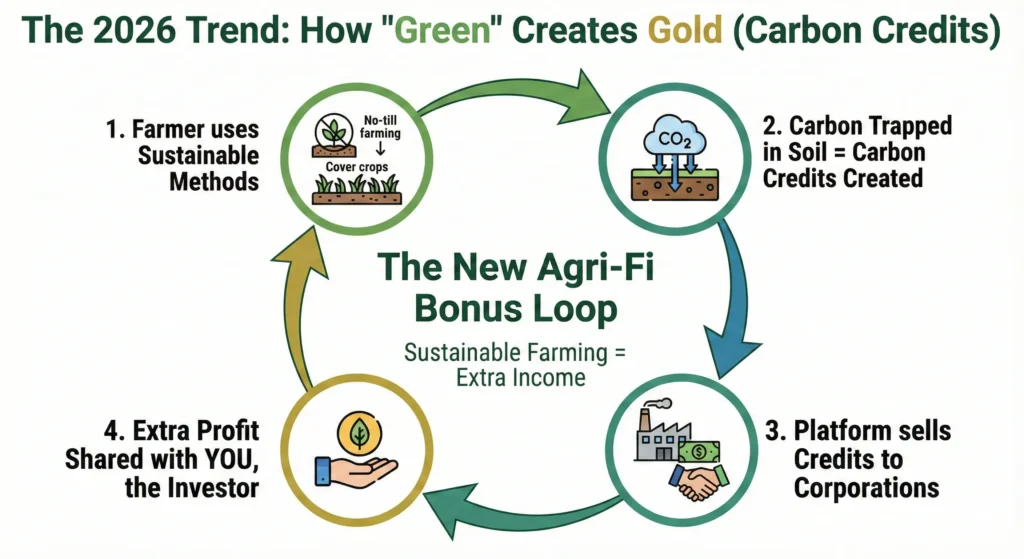
What makes investing in 2026 different from 2024? Carbon Credits.
Many of the platforms above (especially Steward and HeavyFinance) are now integrating “Green Returns.” This means if the farmer uses eco-friendly methods that trap carbon in the soil, they earn Carbon Credits.
These credits are sold to big corporations, and that extra profit is often shared with you, the investor. In 2026, look for platforms that mention “Soil Health” or “Carbon”—it usually means a bonus on your ROI.
Frequently Asked Questions (FAQ)
1. Is my money guaranteed?
No. Agriculture carries risks like weather and disease.6 However, platforms like AcreTrader and HeavyFinance are secured by physical assets (land/machines), so even if the crop fails, there is something of value to sell to recover funds.
2. Can I withdraw my money anytime?
Usually, no. Farming is a long-term game. Most platforms lock your funds for 1 to 5 years. If you need instant access to cash, look at Tokenized options like LandShare.
3. Do I need to be a millionaire to invest?
Not anymore. Platforms like Steward and HeavyFinance allow you to start with less than $100.
Conclusion: Which One Should You Pick?
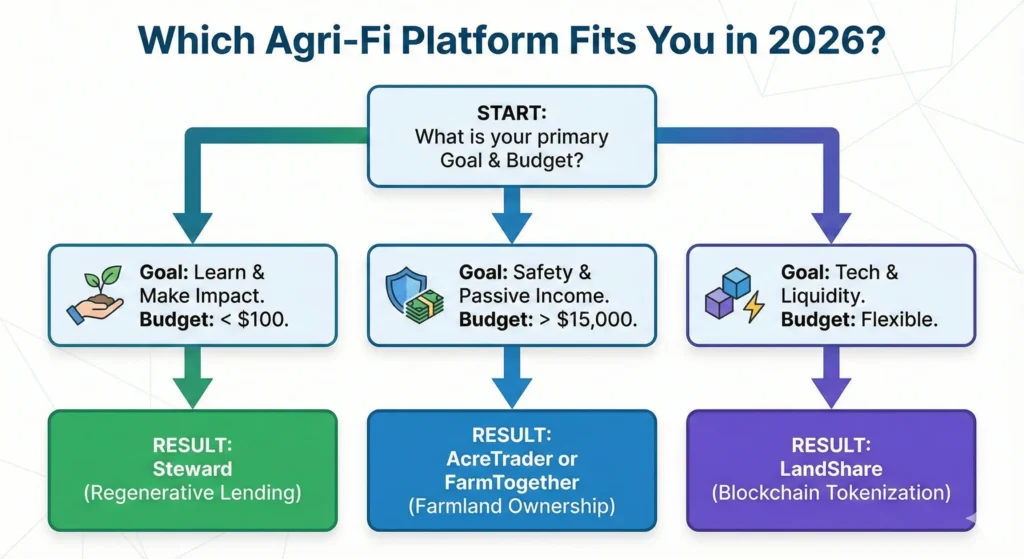
- If you have $100 and want to learn: Start with Steward. It’s safe, easy, and feels good.
- If you have $20,000 and want safety: Go with AcreTrader or FarmTogether. It’s real estate without the headache of being a landlord.
- If you love Tech: Try LandShare to see how blockchain is changing the world.
Agri-Fi in 2026 is no longer the “Wild West.” It is a legitimate, powerful way to diversify your portfolio. Don’t just let your money sit in a bank losing value to inflation—plant it, and watch it grow.